The good news: fixing this isn't complicated once you understand what's actually driving the swing. Let's go through it properly.
Why a couple of degrees actually matters
Temperature and humidity don't act alone — they move together. Growers who've been at this a while don't just track temperature anymore; they track VPD (vapor pressure deficit), which is basically a measure of how much "pulling power" the air has on moisture from your leaves. Too dry, and the plant closes its stomata to protect itself, which slows nutrient uptake. Too humid, and you're inviting mold, especially once buds start forming density.
Rough targets most growers work from:
| Stage | Temp (lights on) | Notes |
|---|---|---|
| Seedling | 68–77°F | Below 65°F, germination stalls |
| Vegetative | 71–82°F | Widest tolerance window |
| Flowering | 68–79°F | Tighter control matters more here |
| Final 1–2 weeks | 68–79°F | Lower end helps preserve terpenes |
A day-to-night drop of around 10°F is normal and even beneficial — it mimics outdoor conditions. What's not normal is a 15–20°F swing because your tent has no way to respond to its own environment.
When your tent is too cold
Cold tents are mostly a winter problem, but a poorly insulated closet or a tent near an exterior wall can run cold year-round. Below 59°F, cannabis basically stops growing. Below 65°F, it's still growing, just slowly and unevenly — and a stalled plant can take two to three weeks to fully recover once conditions improve. That's not a small setback.
A few ways growers fix this:
- A dedicated tent heater. General-purpose space heaters push dry, directional heat that can scorch nearby leaves if it's aimed the wrong way. A heater built for grow tents — like VIVOSUN's AeroFlux Heater — is sized for enclosed spaces and pairs with a thermostat so it isn't just running full blast until you remember to check on it.
- Heat mats under the pot, not just warming the air. Roots respond to soil temperature, not ambient air, so a mat under the tray during germination (and honestly, well past it) keeps nutrient and water uptake steady even if the air above dips.
- Flipping your light schedule. Running lights at night and dark during the day sounds backwards, but if your grow space gets cold overnight, your light fixture is a free heat source you're already paying for. LEDs run cooler than HID, so this trick matters more if you're still on high-pressure sodium.
- Basic insulation. A layer of reflective insulation between the tent and an exterior wall, or just not placing the tent directly under an AC vent, solves half of most "why is my tent always cold" threads.
When your tent is too hot
This is the more common complaint, especially with LED setups pushed close to canopy or tents in a garage that gets afternoon sun. Heat stress shows up as curling leaf edges, wilting, and eventually reduced yield even if the plant technically survives.
What actually helps:
- Increase exhaust, not just intake. A lot of growers add a bigger intake fan when what they actually need is more air leaving the tent. If you're not sure your current fan is big enough for your tent's volume, it's worth checking VIVOSUN's ventilation and ducting kits, which are sized to specific tent dimensions instead of one-size-fits-all.
- A tent-rated AC unit for serious heat problems. If ventilation alone isn't cutting it — common in small rooms with no real air exchange to the outside — a compact unit like VIVOSUN's AeroLush Air Conditioner removes heat instead of just recirculating it, which a fan alone can't do.
- Move to LED if you're still on HID. This is the single biggest lever most people ignore. Watt for watt, LEDs run noticeably cooler at the canopy, which means you can run closer without the heat penalty.
- Light schedule, again. In summer, running lights overnight avoids stacking your light's heat on top of the day's ambient heat.
- CO2 supplementation won't lower temperature, but it raises the ceiling for how much heat your plants can tolerate before they start showing stress — useful if you're already running hot and can't fully fix it.
Stop guessing — automate the correction instead
Here's the part most "how to control temperature" articles skip: manually checking a thermometer twice a day is fine until you have a hot afternoon while you're at work, or a cold front rolls in overnight while you're asleep. The actual fix isn't a better guess — it's a system that reacts before you'd even notice.
This is where VIVOSUN's GrowHub controllers earn their keep. The GrowHub E42A+ runs dual sensors — one inside the tent, one outside — and displays live VPD alongside temperature and humidity, so you're adjusting based on the actual plant-stress metric instead of two disconnected numbers. Pair it with the AeroFlux Heater, AeroLush AC, AeroStream Humidifier, or AeroDrain Dehumidifier, and the controller handles the back-and-forth for you: heat kicks in below your threshold, ventilation ramps up above it, and you get an alert if something's genuinely out of range instead of finding out three days later.
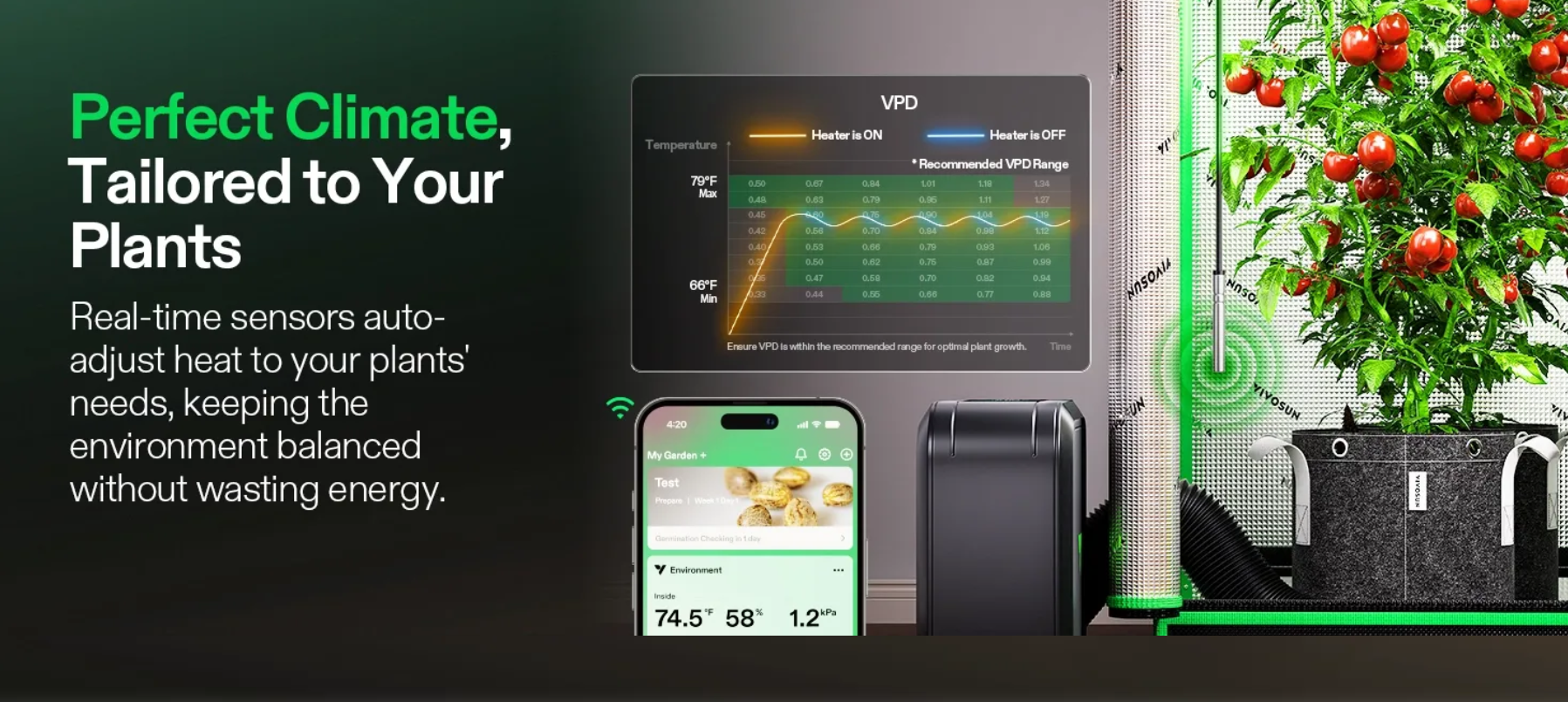
If you want something simpler, the GrowHub A22 Outlet Controller works as a smart thermostat plug for a single device — heater, fan, or humidifier — with the same offline-capable automation, just without the full multi-device dashboard.
A cheap habit that saves you both ways
Buy a real thermometer/hygrometer and actually mount it at canopy height, not clipped near the tent wall where it'll read the wrong number. This sounds too basic to mention, but it's the single most common reason growers think their climate control isn't working when really they've just been measuring the wrong spot the whole time. Prevention is cheaper than recovery, every time.
You may also ask
What's the ideal grow tent temperature for cannabis? Roughly 71–82°F during vegetative growth and 68–79°F during flowering, with a natural 10°F drop at night. Outside those ranges — especially below 65°F or above 85°F — you'll start seeing slowed growth or heat stress.
Do I need an air conditioner for my grow tent, or is a fan enough? If your ambient room temperature is already close to your target, a well-sized exhaust fan is usually enough. If your room itself runs hot with no real way to bring in cooler air, a fan just recirculates heat — that's when a dedicated AC unit becomes worth it.
Can I control VPD without a WiFi controller? Yes, manually, using a hygrometer and a VPD chart — but it takes checking multiple times a day and doing the math yourself each time. A controller like the GrowHub E42A+ automates that calculation and reacts to it in real time, which is the main reason growers upgrade to one.
Still not sure whether your setup needs a heater, an AC unit, or just better ventilation? Join our VIVOSUN Reddit community to discuss your grow setup with fellow growers, or create a VIVOSUN account and get personalized recommendations, exclusive offers, and a better shopping experience.