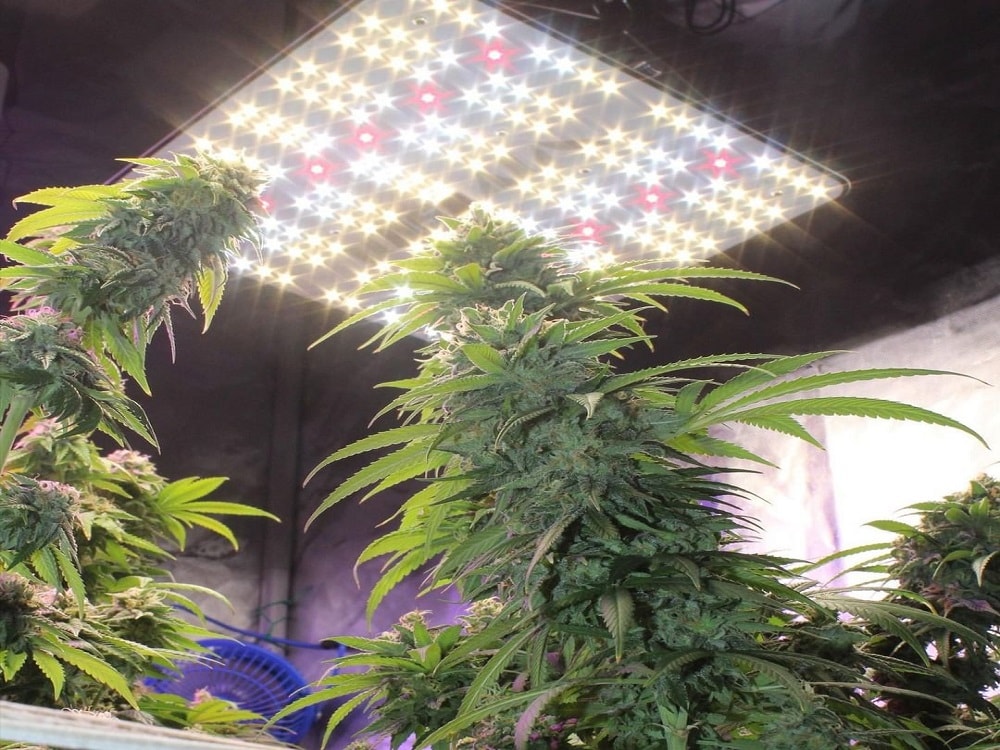
The short answer: For a modern full-spectrum LED grow light, plan on roughly 20–30 watts per square foot for vegetative growth and 30–40 watts per square foot for flowering. A 4×4 tent (16 sq ft) typically needs 480–640W of quality LED power — usually one well-sized fixture or two smaller ones. But wattage alone is a starting point, not the final answer. The actual number of fixtures you need depends on your canopy shape, the light's PPFD map, and how evenly it covers your plants edge-to-edge.
Key Takeaways
- Plan by canopy area, not tent dimensions. If your plants only fill 9 sq ft of a 16 sq ft tent, light for 9 sq ft — or plan ahead for the full footprint when the canopy matures.
- Wattage estimates. PPFD verifies. Two 400W lights can deliver very different results depending on diode efficiency, optics, and fixture design. Always check the manufacturer's PPFD map.
- One light works for square canopies. Two (or more) works better for rectangles. A 4×8 tent almost always benefits from two fixtures instead of one.
- Dimming gives you flexibility. A fixture running at 50% during early veg saves electricity and reduces plant stress — then you crank it up for flower.
A Note Before You Start
If you're growing cannabis or other regulated crops, plant-count and cultivation rules vary by state, province, and country. Check your local regulations before expanding your grow. This guide covers light requirements — it is not legal advice.
Quick-Reference: How Much Wattage Per Square Foot?
Use these ranges as planning estimates for modern full-spectrum LED fixtures (2.5 µmol/J or higher). Older or budget LEDs with lower efficacy may need more wattage to hit the same light levels.
| Growth Stage | Watts per Square Foot | Example: 4×4 Tent (16 sq ft) |
|---|---|---|
| Seedlings & Early Veg | 10–20W | 160–320W (dimmed or smaller fixture) |
| Vegetative Growth | 20–30W | 320–480W |
| Flowering | 30–40W | 480–640W |
| Flowering (with CO₂) | 40–50W | 640–800W |
These are planning ranges, not hard requirements. The higher your fixture's PPE (µmol/J), the more plant-usable light you get per watt — and the lower in the range you can comfortably run. A fixture with 2.8+ µmol/J at 30W/sq ft often outperforms a 1.8 µmol/J fixture at 40W/sq ft.
The Only Formula You Need
Required Wattage = Canopy Area (sq ft) × Watts per Square Foot
Example — 4×4 tent, flowering:
Canopy = 4 × 4 = 16 sq ft
Wattage range = 16 × (30–40W) = 480–640W
Once you have that number, don't stop there. Go find the PPFD map for the fixture you're considering and verify that it actually delivers your target intensity across your full canopy — not just at the dead center.
Why Canopy Area (Not Tent Size) Determines Your Lighting Needs
Your tent might be 5×5, but if your plants currently occupy a 3×3 area, you don't need to light all 25 square feet yet. Match your light to the actual plant footprint.
That said, plan ahead. If you know your canopy will fill the tent by week 3 of flower, size your lighting for the mature footprint. The most common mistake is buying a light that works for early veg but leaves your plants under-lit when they need intensity most.
Other factors that affect coverage:
| Factor | How It Changes Your Lighting Needs |
|---|---|
| Plant height | Taller plants need more penetration; light intensity drops with distance |
| Plant spacing | Tightly packed plants create dense canopies that benefit from more uniform coverage |
| Training method | ScrOG and SOG create flat canopies — bar-style or multi-fixture setups distribute light better |
| Canopy shape | A 2×4 rectangle is better served by a linear bar fixture or two smaller lights than a single square-footprint panel |
How Many Grow Lights for Your Tent Size?
Below is the starting-point reference. The wattage ranges assume modern full-spectrum LEDs at 2.5+ µmol/J. If you're using older or budget fixtures, lean toward the higher end.
| Tent Size | Canopy Area | Veg Wattage | Flowering Wattage | Typical Fixture Count |
|---|---|---|---|---|
| 2×2 ft | 4 sq ft | 80–120W | 120–160W | 1 light |
| 2×4 ft | 8 sq ft | 160–240W | 240–320W | 1–2 lights |
| 3×3 ft | 9 sq ft | 180–270W | 270–360W | 1 light |
| 4×4 ft | 16 sq ft | 320–480W | 480–640W | 1–2 lights |
| 5×5 ft | 25 sq ft | 500–750W | 750–1,000W | 1–2 lights |
| 4×8 ft | 32 sq ft | 640–960W | 960–1,280W | 2+ lights |
| 8×8 ft | 64 sq ft | 1,280–1,920W | 1,920–2,560W | Multiple fixtures |
| 10×10 ft | 100 sq ft | 2,000–3,000W | 3,000–4,000W | Multiple fixtures |
Always verify against the manufacturer's PPFD map and recommended coverage before buying. Two different 400W fixtures can produce meaningfully different canopy coverage.
One Large Light vs. Multiple Smaller Lights
Both strategies work. The right one depends on your canopy shape, fixture design, and how much control you want.
When One Large Light Makes Sense
- Small to medium square tents (2×2, 3×3, 4×4)
- Compact, well-centered canopies
- You want simple installation — one plug, one set of hanging hardware, one control
- Fewer cables and mounting points to manage
When Multiple Smaller Lights Work Better
- Rectangular canopies (2×4, 4×8, 5×10)
- You need better edge-to-edge uniformity
- Different sections of your canopy are at different growth stages
- You want independent dimming control per zone
- A single fixture's PPFD map shows significant drop-off at the edges for your tent size
Example: In a 4×8 tent, one fixture centered overhead will almost always leave the outer edges under-lit. Two fixtures positioned side-by-side each covering 4×4 feet deliver far more consistent PPFD across the full canopy.
The goal isn't to maximize total wattage — it's to deliver uniform PPFD across every square foot your plants occupy.
PPFD and PAR: The Metrics That Actually Matter
Wattage tells you what your fixture pulls from the wall. It doesn't tell you how much of that electricity becomes plant-usable light.
| Term | What It Means | Why It Matters |
|---|---|---|
| PAR (Photosynthetically Active Radiation) | Light in the 400–700 nm range that drives photosynthesis | This is the spectrum plants actually use |
| PPFD (Photosynthetic Photon Flux Density) | How many PAR photons hit a specific area per second, measured in µmol/m²/s | This is the number you care about at your canopy |
| PPE (Photosynthetic Photon Efficacy) | How efficiently the fixture converts electricity into PAR photons, measured in µmol/J | Higher PPE = more light per watt = lower electricity bills |
| DLI (Daily Light Integral) | Total PAR photons received over an entire day, measured in mol/m²/day | Accounts for both intensity (PPFD) and duration (photoperiod) |
Typical PPFD Targets by Growth Stage
| Growth Stage | PPFD Range (µmol/m²/s) | Typical Photoperiod |
|---|---|---|
| Seedlings & Clones | 100–300 | 16–18 hours |
| Vegetative Growth | 300–600 | 16–18 hours |
| Flowering (Weeks 1–4) | 600–800 | 12 hours |
| Flowering (Weeks 5+) | 800–1,000 | 12 hours |
| Flowering with CO₂ enrichment | 1,000–1,500+ | 12 hours |
These ranges are general guidelines. Different strains, environments, and CO₂ levels shift the optimal PPFD. Start conservative and increase incrementally — plants communicate stress through leaf posture, color, and edge curl long before visible damage appears.
DLI: When PPFD Meets Photoperiod
PPFD measures light intensity at a single moment. DLI (Daily Light Integral) measures total light received over a full day — which is what drives growth and yield.
DLI (mol/m²/day) = PPFD × Hours of Light × 0.0036
Example: 500 µmol/m²/s × 18 hours × 0.0036 = 32.4 mol/m²/day
| Crop Type | Vegetative DLI Target | Flowering DLI Target |
|---|---|---|
| Leafy Greens & Herbs | 12–17 | N/A (harvested in veg) |
| Cannabis | 20–30 | 30–45 |
| Tomatoes & Peppers | 15–25 | 25–35 |
DLI is especially useful when you're deciding between running a light at full intensity for 12 hours vs. dimmed for 18 hours. The math tells you which approach hits your DLI target with less electricity and less heat.
Why PPFD Maps Are Non-Negotiable
A PPFD map shows measured light intensity at different positions under the fixture at a specified hanging height. It's the single most important document to review before buying a grow light.
What to look for on a PPFD map:
- Average PPFD — the mean across the entire footprint
- Edge and corner PPFD — the lowest readings on the map; these determine whether your outer plants get enough light
- Uniformity ratio — edge PPFD ÷ center PPFD. 0.7 or higher is decent; 0.85+ is excellent
- Hanging height — the map is only valid at whatever height it was measured (usually 12", 18", or 24")
- PPE (µmol/J) — total PPF output ÷ fixture wattage. Look for 2.5+ in 2026; 2.8+ is great for home grows
A fixture with a high center PPFD and poor edge uniformity might look impressive on a spec sheet but delivers uneven results in practice. Two smaller, well-distributed fixtures often outperform one big light with a steep drop-off.
VIVOSUN Grow Light Recommendations by Tent Size
Once you've calculated your wattage range, match it to a fixture designed for your tent footprint. VIVOSUN's LED grow light lineup includes two main families:
AeroLight Series (Integrated Circulation Fan — All Models)
Every AeroLight model includes a built-in EC circulation fan (84 CFM, 33 dB) that runs off the same power supply — reducing the need for separate clip fans. All models feature Samsung diodes, full-spectrum tuning (380–780nm with 660nm deep red and 730nm far-red), IP65 waterproof rating, 50,000+ hour lifespan, and GrowHub controller compatibility for app-based scheduling and dimming.
| Model | Wattage | Flower Footprint | Veg Footprint | PPE | Best For |
|---|---|---|---|---|---|
| AeroLight A100 (VSA100) | 100W | 2×2 ft | 2×2 ft | — | 2×2 tents, compact single-plant setups |
| AeroLight 120W | 120W | 2×2 ft | 3×3 ft | — | Small tents needing extra headroom |
| AeroLight 180W | 200W | 2.7 ×2.7 ft | 4×4 ft | — | 2×4 and 3×3 tents |
| AeroLight Wing AW200SE | 200W | 2×4 ft | 4×4 ft | 2.75 µmol/J | 2×4 / 3×3 tents, adjustable wing angles |
| AeroLight Bar 320W | 320W | 4×2 ft | 4×4 ft | 2.96 µmol/J | 2×4 tents, bar-style for even spread |
| AeroLight Bar 550W | 550W | 4×4 ft | 5×5 ft | 2.96 µmol/J | 4×4 tents, flagship high-output |
LumaLight Series (Fanless, Value-Focused)
LumaLight fixtures use a quiet, fanless heatsink design. All models are full-spectrum (3000K, 5000K, 660nm, 730nm), IP65 rated, dimmable (25%/50%/75%/100%/OFF knob + app stepless dimming), and GrowHub compatible. Q90 lifespan: 36,000 hours. 5-year warranty.
| Model | Wattage | Flower Footprint | Veg Footprint | PPFD (at 12") | Key Feature |
|---|---|---|---|---|---|
| LumaLight 100W | 100W | 2×2 ft | 2×4 ft | 521 µmol/m²/s | Entry-level, ultra-compact (12×12 in) |
| LumaLight 150W | 150W | 2.7×2.7 ft / 3×3 ft | 3×3 ft | 818 µmol/m²/s | Adjust light intensity via the 4-level dimming |
| LumaLight 200W | 200W | 2×4 ft / 3×3 ft | 4×4 ft | 751 µmol/m²/s | Full Spectrum, intelligent dimming control |
| LumaLight 320W | 320W | 3×3 ft | 4×4 ft | 869 µmol/m²/s | Micro-lens optics, deep canopy penetration |
| LumaLight 400W | 400W | 4×4 ft | 5×5 ft | 967 µmol/m²/s | Square board, high PPFD |
| LumaLight 500W | 500W | 3×3 ft / 4×4 ft | — | 845 µmol/m²/s | Mid-size bar design |
| LumaLight 750W | 750W | 5×5 ft | — | 900 µmol/m²/s | Flagship, micro-lens + bar matrix |
Example Setups by Tent Size
| Tent Size | Flowering Wattage Range | Option A (Single Fixture) | Option B (Multiple Fixtures) |
|---|---|---|---|
| 2×2 ft | 120–160W | LumaLight 100W or AeroLight A100 | N/A |
| 2×4 ft | 240–320W | AeroLight Wing 200W or LumaLight 200W | Two LumaLight 100W or LumaLight 150W |
| 3×3 ft | 270–360W | LumaLight 320W | AeroLight 350W |
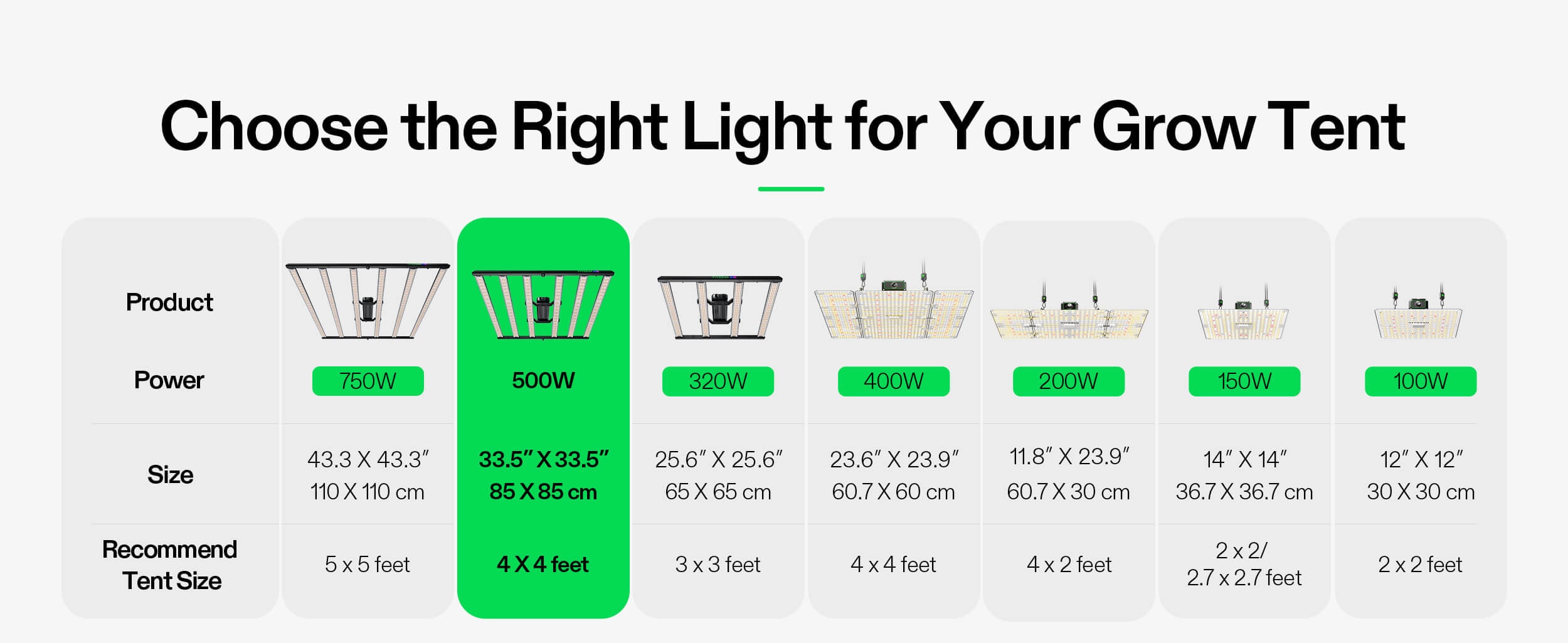
| 4×4 ft | 480–640W | LumaLight 400W or AeroLight Bar 550W | Two AeroLight Wing 200W fixtures (400W total, excellent uniformity) |
| 5×5 ft | 750–1,000W | LumaLight 750W or AreoLight 850W | Two LumaLight 400W fixtures |
| 4×8 ft | 960–1,280W | - | Two AeroLight 550W |
Walkthrough: Choosing a Light for a 4×4 Tent
- Calculate canopy: 4 × 4 = 16 sq ft
- Determine wattage range (flowering): 16 × 30–40W = 480–640W
- Check single-fixture options: The LumaLight 400W falls just under the 480W low end but delivers solid coverage for most home grows. The AeroLight Bar 550W (550W, 2.96 µmol/J) sits comfortably inside the range with best-in-class efficiency and the bonus of an integrated circulation fan.
- Check multi-fixture options: Two AeroLight Wing 200W fixtures (400W total) can be positioned for excellent edge-to-edge uniformity — you gain per-zone dimming and redundant airflow, at the cost of a second set of mounting hardware.
- Verify with the PPFD map: Before committing, confirm the fixture's PPFD map at your intended hanging height meets your target for the growth stage. A light that hits 900+ PPFD in the center but drops to 400 in the corners will give you uneven results no matter the wattage.
How to Know If You Need More Than One Grow Light
Add a second fixture when a single light can't give you uniform PPFD across your full canopy. Signs include:
- Plants at the edges growing noticeably slower or stretching toward the center
- PPFD readings at the corners below your target range
- A rectangular canopy (e.g., 2×4, 4×8) that exceeds your fixture's natural footprint
- Can't reach your target PPFD without pushing center intensity into light-stress territory
Two fixtures don't just add power — they let you spread the same total wattage more evenly by reducing the distance between each light source and the farthest plants.
How Far Should Grow Lights Be From Plants?
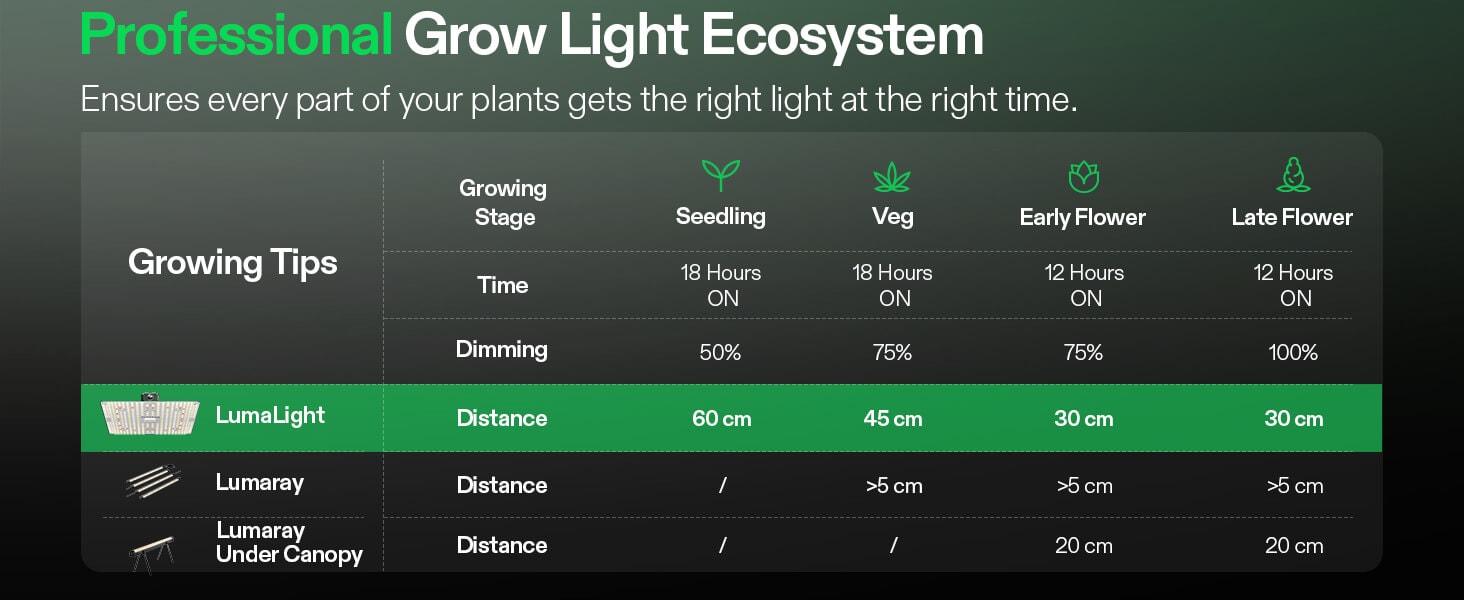
Hanging height directly affects both intensity and coverage. Move the light closer: higher PPFD, smaller footprint. Move it higher: lower PPFD, wider coverage. There's no universal "correct" distance — it depends on your fixture, dimming level, and plant stage.
For detailed guidance per growth stage:
- How Far Away Should My Grow Lights Be? — general hanging-height guide
- How Far Should Seedlings Be From a Grow Light? — seedling-specific recommendations
Always defer to your fixture's manufacturer PPFD map at the recommended height — it's more reliable than a generic distance chart.
Frequently Asked Questions
How many watts do I need for a 4×4 grow tent?
A 4×4 canopy covers 16 square feet. For flowering with modern full-spectrum LEDs, plan on 480–640W. For vegetative growth, 320–480W is usually sufficient. The exact number depends on your fixture's efficiency (µmol/J) — a high-efficacy 400W light can sometimes match the canopy coverage of a less efficient 550W model.
How many grow lights should I use in a 4×4 tent?
One well-sized fixture (430W+ class) typically handles a 4×4 canopy. For example, a single LumaLight 400W or AeroLight Bar 550W covers a 4×4 footprint. Two 200W-class fixtures positioned side-by-side can provide better edge-to-edge uniformity and independent dimming per zone. Either approach works — the decision comes down to the PPFD map and your preference for simplicity vs. flexibility.
Is one large grow light better than multiple smaller ones?
For square canopies under 5×5, one properly sized fixture is usually simpler and works well. For rectangular spaces (2×4, 4×8) or canopies over 5×5, multiple fixtures almost always deliver more uniform coverage. There's no universal "better" — it depends on your canopy shape and the specific fixture's coverage pattern.
Does higher wattage always mean more growth?
No. Wattage is electrical input — not plant-usable light output. A 320W fixture at 2.96 µmol/J delivers more PAR photons to your canopy than a 400W fixture at 2.0 µmol/J, while using less electricity and generating less heat. PPFD and PPE are better predictors of growth than wattage alone.
Can two 200W lights replace one 400W light?
They provide the same total electrical input, but the results depend on how you position them. Two 200W fixtures can distribute light more evenly across a rectangular or large canopy. One 400W fixture is simpler to install and manage. Match the approach to your canopy shape.
How do I know if my grow light is actually strong enough?
Check the manufacturer's PPFD map at your intended hanging height. Compare the reported PPFD (especially at the edges and corners) against the target ranges for your plant's growth stage. If the edge readings are more than 30–40% lower than the center, your light isn't covering the canopy evenly — consider repositioning or adding a second fixture.
Can I connect multiple grow lights to one controller?
Many VIVOSUN fixtures are compatible with the GrowHub Controller (E42A or E25) for centralized scheduling, dimming, sunrise/sunset simulation, and environmental triggers. Check the compatibility details for your specific light model and controller version before connecting multiple fixtures.
How much will my electricity bill go up?
A 430W LED on an 18/6 schedule adds about 232 kWh per month — roughly $41/month at the 2026 U.S. average residential rate of ~17.5¢/kWh. During 12/12 flowering, it drops to about $27/month. See our complete grow light electricity cost guide for a detailed breakdown by tent size and electricity rate.
More Grow Light Resources
- LED Grow Light Buying Guide: How to Choose the Right VIVOSUN Light — compares all four VIVOSUN product families
- How Far Away Should My Grow Lights Be? — hanging height and distance guide
- How Far Should Seedlings Be From a Grow Light? — seedling-stage specific recommendations
- How Much Does It Cost to Run a Grow Light? — electricity cost breakdown by tent size and rate
- Under Canopy Lighting: When, Why & How — supplementing top lighting for bigger harvests
Last updated: August 2026. Product specifications and electricity rates reflect data available as of this date. VIVOSUN periodically updates product lines — always check current fixture specs and PPFD maps on the official product pages before purchasing.